This is where it all started…
Nearly ten years ago, we began dealing exclusively in Chinese Snuff Bottles. We hand carried them from China and sold them to antique stores throughout Maryland. In 1999 we launched The Snuff Bottle Store and began selling online. Since then our passion for Asian Art has continued to grow and expand, and our website selection has grown as well. Today we stock thousands of products from 15 different countries around the world.
Select from the menu on the left or links below.
Featured Products:
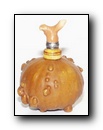
Antique & Unique Snuff Bottles – Our buyers scour the country side and cities of China in search of Antique Snuff Bottles. Over the years they have managed to secure some amazing pieces for us. Our pricing policy for antique bottles is a cost-plus program which means if we get a bargain on a bottle, we pass the savings on.
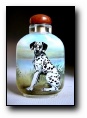
Inside Painted Snuff Bottles – One of the most famous and collectible types of snuff bottles is the inside or reverse painted. These little masterpieces are painted by reaching down through the neck of the bottle with a tiny curved brush or piece of bamboo. If painting through a quarter inch hole wasn’t difficult enough, you also have to paint the object in reverse order since the first drop of paint to touch the glass will be in front of subsequent brush strokes. Thus the details must be painted before the subject. Eyes first, then face, then background. The “reverse” of how typical painters work.
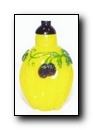
Peking Overlay Glass Snuff Bottles – Starting with a glass bottle they dip it one or more times into contrasting colors of molten glass, allowing each layer to cool and harden. Next, the layers are carefully carved away to create beautiful designs.
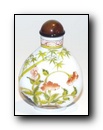
Guyuexuan / Enamel Glass Snuff Bottles – “Ancient Moon Pavilion” is the translation for this style of bottle. It is named after the Imperial workshop that first created the method for making these bottles. Glass bottles are painted with enamels then fired in a kiln. What makes this process unique is that there is only a few degree difference between the temperature required to fuse the enamels to the glass and the temperature at which the bottle melts and collapses.
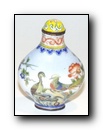
Enamel / Brass Snuff Bottles – Tiny brass bottles are molded first. Next, the entire bottle is coated with a thin layer of porcelain to provide a super smooth surface. The bottle is fired in a kiln to harden the porcelain. Next the porcelain layer is sanded smooth and the enamels are applied. Once the designs are completed, the bottle is coated in a clear glazed and again fired in a kiln.
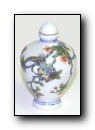
Porcelain Snuff Bottles – The first specimens of Chinese porcelain date back approximately to 4000 B.C. whereas, the white ware, high fired type of pottery associated with the Tang Dynasty goes back to somewhere around 500 B.C. Our assortment of porcelain snuff bottles showcases some of the many methods used today.
Sale Snuff Bottles – If you are looking for a bargain, keep an eye on this category. We add items on a regular basis. None of the bottles in the clearance section are defective or damaged. Just a little less expensive.
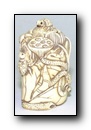
Bone & Horn Snuff Bottles – And other organic materials. Our selection includes Mammoth Ivory, Bone, Horn, and Wood Snuff Bottles. Each bottle is individually hand crafted and no two are identical.
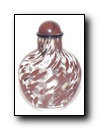
Colored Art Glass Snuff Bottles – The art of glass blowing has evolved into one of the most amazing art-forms. See our selection of mottled, speckled, carved, and twisted glass snuff bottles. Each bottle is hand blown and takes the artist hours to complete.
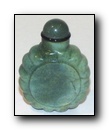
Carved Stone Snuff Bottles – Choose from a wide selection of specimen stones ranging from Agate to Jade. These bottles are selected not only for the carving work but the patterns in the stones themselves. Many are made from rare and difficult to find materials. Most of our stone bottles are carved in the homes of the artist to supplement their income practicing an art that has been passed down through the generations.
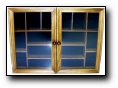
Curios & Stands – We stock a variety of stands and curios selected specifically for displaying your collection of Netsuke, Ojime, or Snuff Bottles.
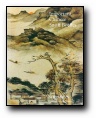
Snuff Bottle Auction Catalogs – From time to time we are able to acquire catalogs from Sotheby’s and Christies featuring the auction of world famous collections of Chinese Snuff Bottles. If you are interested in purchasing these, keep an eye on this section.
Snuff Bottle History
Both Chinese snuff bottles, as well as the tobacco powder contained by the Chinese snuff bottles were at the very core of a fashion whose popularity had never before been experienced in China’s extensive history. Due to it’s exceptional versatility of style, technique and material, all in one small object, as well as the fine craftsmanship, these tiny masterpieces quickly became one of the most notable representations of the use of artistic skill throughout the Qing Dynasty.
There are many different beliefs as to who introduced the use of tobacco to the Chinese. I have read that the Russians, Manchu, Portuguese, and the Jesuit Priests brought tobacco to China. I would venture to say that it is likely that different people, around the same time, introduced it in different regions. That time would be the early to mid 1600’s.
Although legally, the smoking of tobacco was not permitted, its use as snuff was considered perfectly acceptable, as it was thought to have valuable medicinal applications. Tobacco was thought to be a great way to treat colds, headaches, stomach disorders and many other symptoms and illnesses. Powdered tobacco, as well as the majority of other Chinese medications, was dispensed in bottles, as opposed to the boxes that were used in Europe.
Though snuff was originally only a luxury experienced by the elite of the new Qing Dynasty house, its popularity, along with the popularity of the snuff bottle, became much more available in and around the Beijing court by the close of the seventeenth century. The heart of the recognition of snuff and snuff bottles remained in and around Beijing’s court until the end of the eighteenth century, developing the use of snuff into a common social ritual for the upper classes. The snuff therefore had to be contained in something that would contribute to this newfound fashion, and therefore, large amounts of art, taste and money were spent on the acquisition of attractive snuff bottles. Snuff bottles also started being used for the attainment of favors, positions, status as well as advancement in government.
During the 1700’s snuff increased in popularity among the Chinese, which created a great demand for Snuff Bottles. They became conversation pieces and collectable items almost immediately. Collecting snuff bottles became the newest nationwide habit, and it spread to all of the social classes with the actual snuff-taking, at the very end of the eighteenth century. The finer the snuff bottle, the more respected was its owner.
Snuff bottles were made out of every material of which the Chinese knew. This included glass, porcelain, jade and other hardstones, ivory, coral, lacquer, amber, wood, etc.
Peking Overlay and Art Glass Techniques:

The first style or type of Peking Glass bottle is the translucent or opaque single color bottle. These bottles are made in every color imaginable. These were also the first glass snuff bottles to be produced. One of the most popular colors produced was “Imperial Yellow”.

Mottled Glass is a mixture of several different colors of glass that are combine in a molten state to create patterns and swirls. Many different interesting designs can be create with this technique. Flakes of gold are sometimes added as in the example.

Carved Glass bottles are typically made from a single color glass and either molded or carved. Most of the bottles are carved from a small block of glass and hollowed out as a stone snuff bottle would be.

Glass Imitating other materials gave the artist an opportunity to display the best qualities of their glass making skills. Many of these bottles are nearly impossible to distinguish from the real materials without using some type of magnifier.

Single color overlay bottles are made with one color base glass and a contrasting color overlay. The base color is most frequently either clear or opaque white. The lesser quality overlay bottles are all single color overlay, but some very high quality bottles are also produced. When determining the value of a Peking Glass bottle the details in the carving is the most important aspect.

Bubble Glass snuff bottles are made by heating the molten glass to a very high temperature and forcing air into the mixture. Impurities are also added to the mixture to produce the snowflake glass. Most of the Bubble Glass bottles are clear glass but some colored bubble glass bottles are made as well.

Multi-color overlay are made by using different colors side by side on the top layer. Two basic grades of these bottles exist. The first and least expensive uses random placement of the color. The second and better quality, the different colors are part of separate components of the design

Seal Type overlay bottles have a very delicate “seal” carved on the bottle. This seal is the Name of the Artist, Name of the School in which he works, or the Dynasty after which the design was made.

Multi-Layer overlay are perhaps the most desirable of all Peking Glass bottles. They require much more expertise and are generally only made by the most experience artists. These can be two layers of overlay glass to as many as four or five layers. The quality of the carving and the thickness of the layer both play a part in determining the value. (the thinner the layers the better)

Carved Multi-layer overlay is perhaps the finest display of glass carving there is. The base glass is first carved in the shape of a flower or fruit, then multiple layers are added. Each layer is perfectly carved to expose only certain parts of the layer below.